MOONSTRA
Adara Ankle Chain
Adara Ankle Chain
Couldn't load pickup availability
A jewel of character and light.
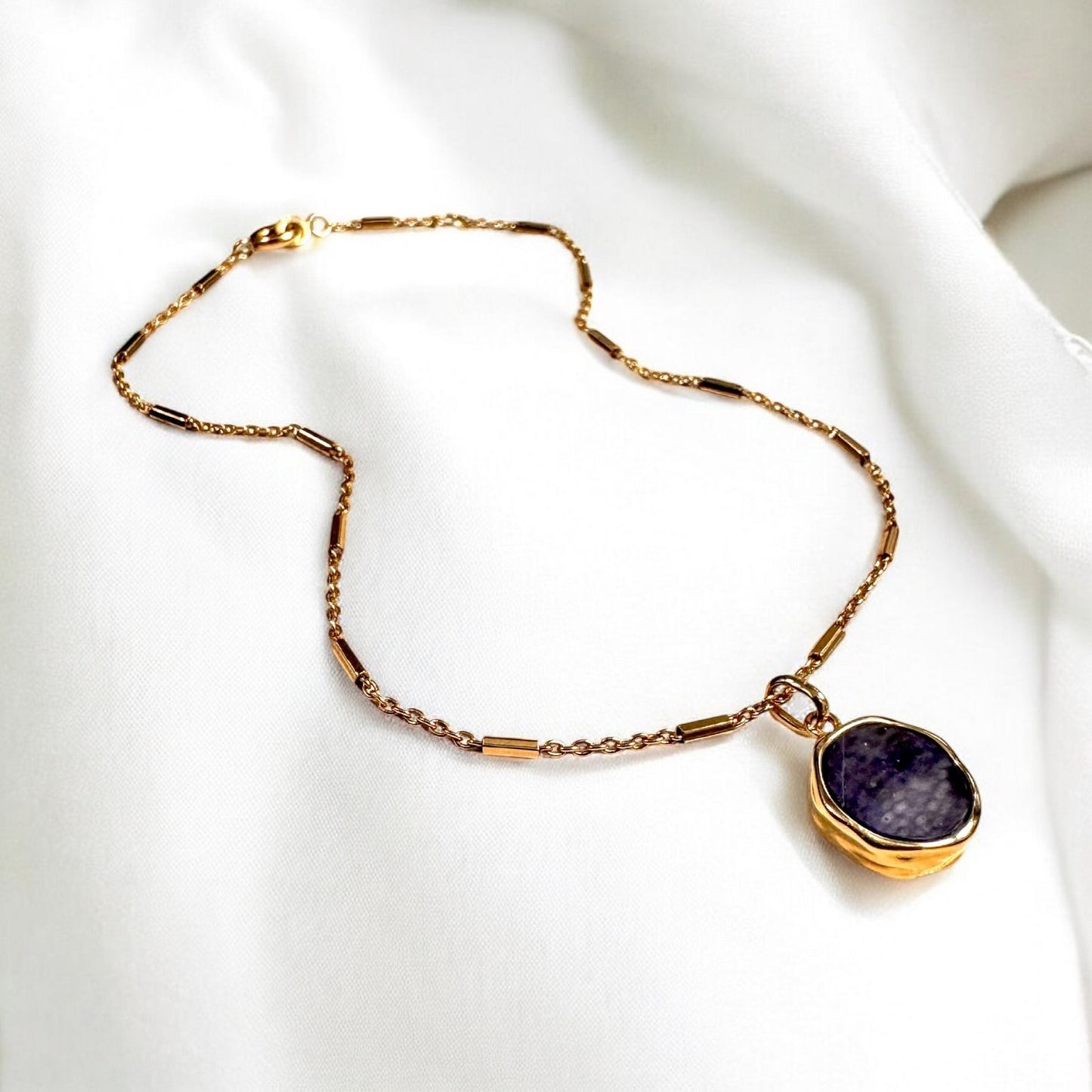
The Adara anklet combines the nobility of 18-carat gold plating with the deep energy of Sodalite, a blue stone with night reflections.
Its irregular round stone evokes natural beauty and harmony.
The jewel
- Materials: Gold-plated and Sodalite stone. 3-micron thick 18-carat gold plating, nickel and cadmium-free, on a brass base.
- Appearance: Chain composed of small bars adorned with an irregular round dark blue Sodalite stone.
- Colors: Gold and dark blue.
- Chain dimensions: 25 cm (23 cm + 2 cm extension).
- Charm dimensions: 12 mm wide by 18 mm long.
Jewel presentation
The jewel is presented and sent in a MOONSTRA branded box.

A card is included, which features:
- On its front, a scannable QR code leading to a product sheet detailing the characteristics of the jewel, its meaning, how to choose a size, and usage and care tips.
- On its back, scannable QR codes leading to the MOONSTRA website and its associated Facebook and Instagram pages.
The collection
Make your style shine with the Adara Collection, inspired by celestial beauty and the moon's golden reflections.
Each piece celebrates femininity, confidence, and inner light.
Discover the Adara Collection, moonstrez the photo!

The symbolism of the jewel and the virtues of the stone in lithotherapy
The name of the jewel is inspired by the Greek and Arabic name "Adara" which means "Beauty".
Gold plating is a process steeped in history. This gilding technique has been used worldwide since antiquity. Formerly a sign of wealth and power, it now conveys elegance.
Sodalite stone, also known as "salt stone," was discovered relatively recently and therefore has little history. It is found mainly in Brazil, Bolivia, India, South Africa, Greenland, Canada, and the United States.
Today, in lithotherapy, this stone symbolizes intelligence. It aids understanding and protects against dangers. It reduces fears and anxieties and develops self-confidence. It is associated with the throat and third eye chakras.
Lithotherapy is a pseudoscientific practice of unconventional medicine based on the belief in a power that certain stones are said to possess, which, through their vibrations and energies, help to improve psychological and physical well-being or even cure diseases. However, there is no scientific evidence for these benefits. The practice of lithotherapy and the use of stones should therefore not replace medical advice.
In lithotherapy, stones purify and recharge their energies naturally in their natural state when in contact with the earth, water, or the light of the moon or sun.
When removed from their environment, they lose their positive energies and must be purified and recharged.
Thus, you can purify them by rinsing them or immersing them for a few minutes in clear or demineralized water, by placing them in a singing bowl that you make sing and vibrate, or by burning a sage or incense stick and exposing them to the smoke.
To recharge them, expose them all night to the light of the moon, preferably a full moon. You can also expose them to the sun, but avoid prolonged exposure (less than an hour) as the sun's rays can eventually dull certain stones. Therefore, prefer sunrise or sunset when the radiation is gentle.
You can also bury them on a full moon, leaving them underground for an entire lunar cycle or for several months, or place them for several hours or days on a cluster of Quartz.
Choosing your size
Before ordering your anklet, check the size that suits you.
The size depends on the shape of your ankle and how you wish to wear it.
Measure the circumference of your ankle with a flexible tape measure, or if you don't have one, use a string or a strip of paper and then measure its length with a ruler.
Generally, the measurement is taken at the bottom of the ankle at the malleolus (the "bony ball" you have on the side and outside of your foot).
The anklet size is usually 1 to 2 cm larger than the ankle circumference. It all depends on how you want to wear it, loose or tighter, but it should be able to turn easily around the ankle.
The anklet should not be too tight or too loose to avoid injury, discomfort, or lack of elegance.
It is advisable to measure a well-fitting one that you wear regularly to help you choose the size of the new one you wish to order.
Usage and care tips
To preserve the jewel from premature aging and maintain its shine, MOONSTRA advises you to avoid:
- exposing it to fresh, salt, or chlorinated water. Remove the jewel before showering or swimming.
- exposing it to sand and salt. Remove the jewel before going to the beach.
- exposing it directly to perfumes, deodorants, creams, and other cosmetic products. Wait for the products to be absorbed by the skin before putting on the jewel.
- exposing it to oxidizing products. Remove the jewel before doing housework or DIY.
- exposing it to heavy perspiration. Remove the jewel before any intense physical activity.
- keeping it on for sleeping and manual activities.
To clean and polish the jewel, MOONSTRA advises you to gently rub it with a soft-bristled brush moistened with water combined with a mild shampoo or Marseille soap, then rinse it with clear water and finally dry it with a soft cloth.